
\n
Last updated: June 9, 2026
\n
Here is the expanded article:
\n
\n
 \n
\n
\nImage: Snappyit\nPicture this: a white seamless backdrop, two softboxes casting clean, wrap-around light, and a silk blouse draped on a mannequin – every fold deliberate, every shadow earning its place. That image has been the standard for apparel photography for decades. But in 2026, the economics behind it have quietly cracked open, and the brands paying attention are rethinking every line item.
\n
Clothing photography cost has always been the quiet tax on small fashion businesses. You design the garment, source the fabric, nail the fit – and then you hand a significant portion of your margin to a photographer, a model, a studio, and a retoucher before a single customer ever sees the product. For years, the only real question was how much you could afford to spend. Now there’s a second question worth asking: whether you need to spend it at all.
\n
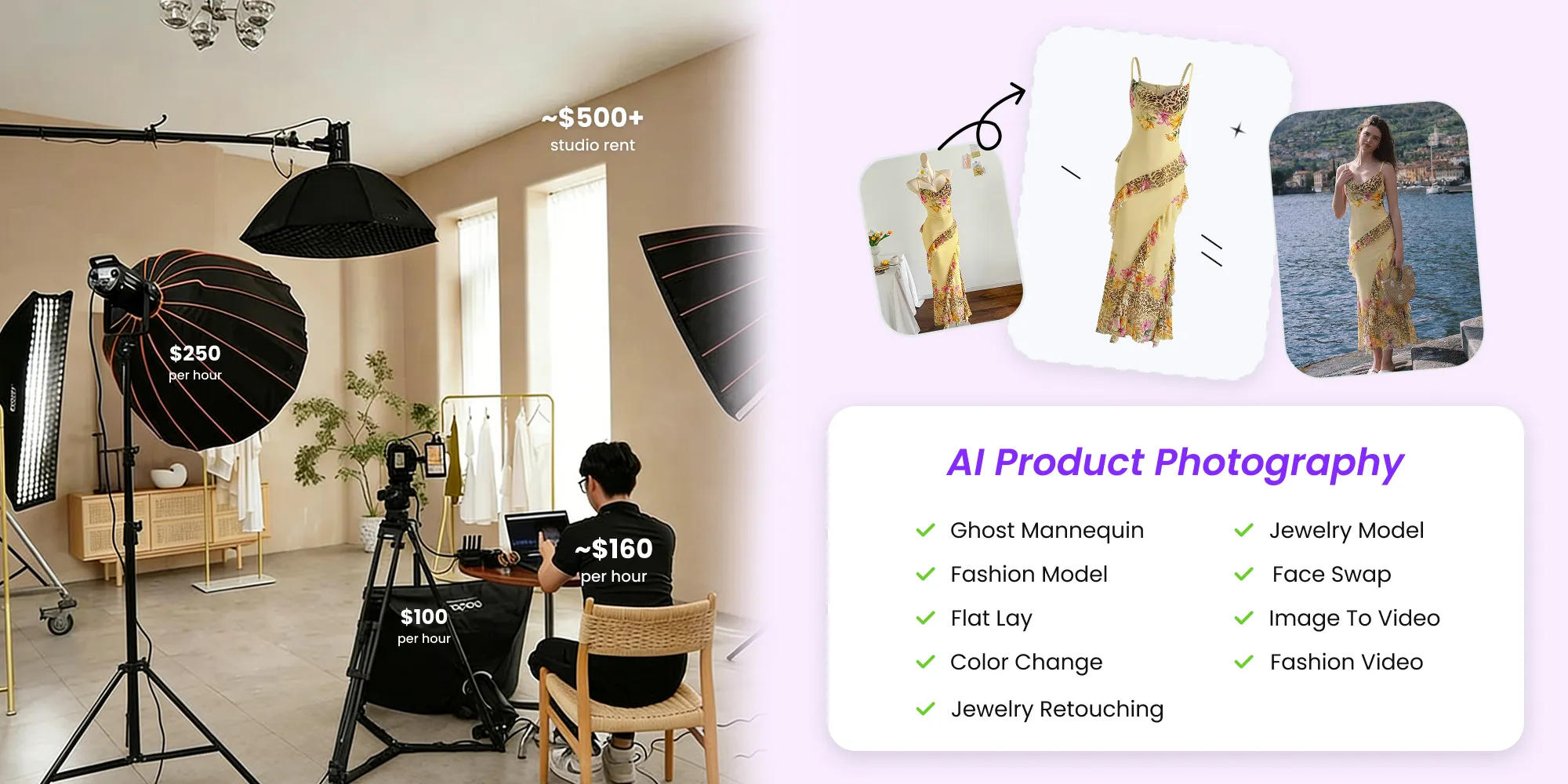
What Does Clothing Photography Actually Cost?
\n
 \n
\n
\nImage: Snappyit
\n
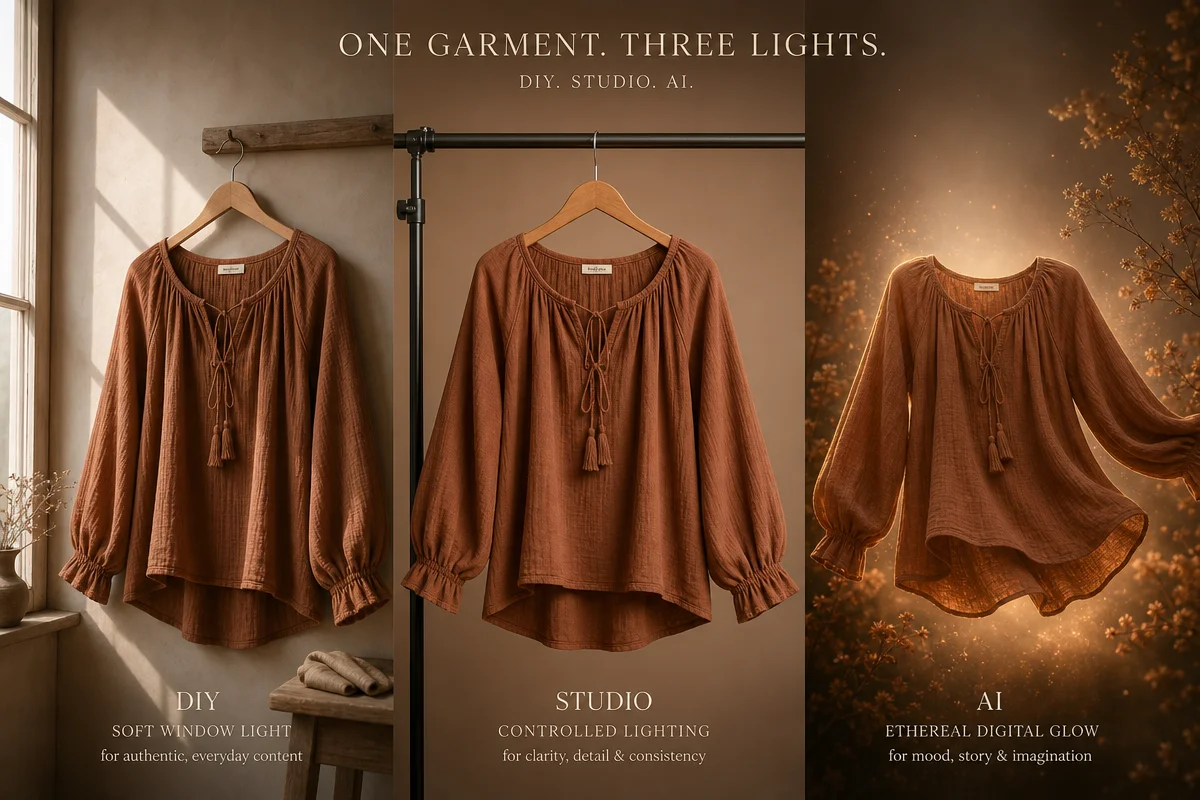
The honest answer is: it depends entirely on which route you take, and the gap between routes is now wider than it has ever been.
\n
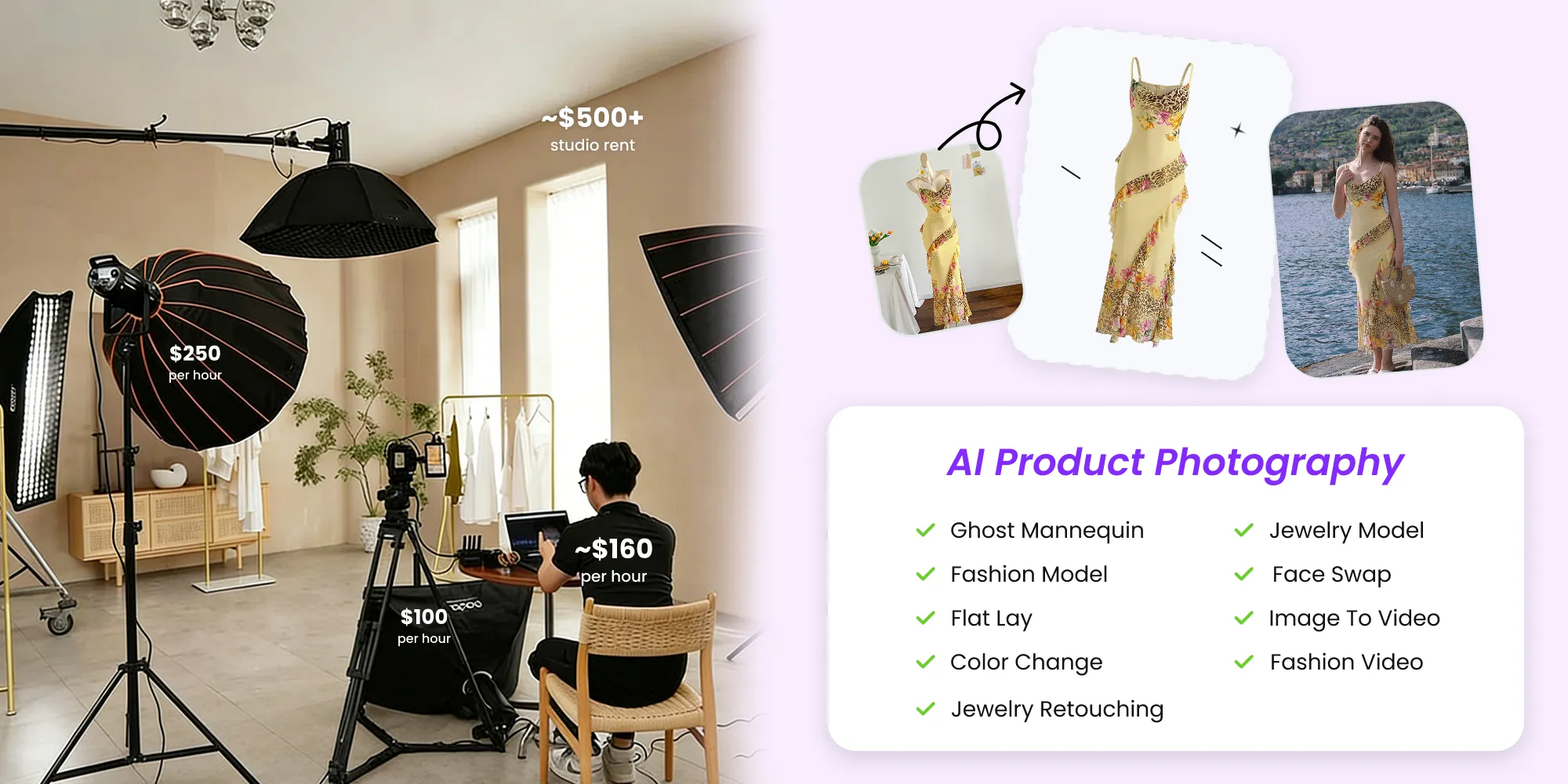
DIY is the entry point. A workable setup runs £120-£400 one-time in the UK (roughly $150-$500 US): a smartphone you likely already own, a two-softbox or ring-light kit ($40-$120), a sweep backdrop in white or grey ($20-$60), and a dress form or mannequin ($30-$100). The ongoing cost isn’t money – it’s time. Shooting, culling, and basic retouching runs 20-40 minutes per garment, which translates to $7-$13 of imputed labour per image if you value your time at a modest $20 per hour. For small runs of 10-20 pieces, that’s manageable. For a 200-piece catalogue drop, it’s weeks of your life.
\n
Traditional studio shoots are where costs stack fast. A professional fashion photographer day rate in 2026 sits between $800 and $3,000 – and that’s before you’ve touched the model, the stylist, the studio hire, or post-production. These aren’t optional extras; they’re load-bearing costs. By the time you’ve assembled the full crew for an on-model catalogue shoot, a modest 50-image drop can land at $4,500 or more. Per-image, you’re looking at $85-$250 for traditional studio work, according to industry pricing data from specialist apparel photography studios.
\n
AI-generated imagery sits at the opposite end entirely: $3-$12 per on-model image from current AI platforms, and as low as $0.49-$2.50 for ghost mannequin-style outputs. The same catalogue drop that costs $4,500 through a studio can run approximately $90 using AI-generated images. That’s not a rounding difference. That’s a structural shift.
\n
Why the Studio Price Tag Is Built the Way It Is
\n
The studio rate isn’t just covering the photographer – it’s covering an entire ecosystem of specialised labour that we’ve historically taken for granted.
\n
Consider what a traditional on-model shoot actually requires: casting calls, model day rates, a stylist to steam and pin and fuss, a studio rental that charges by the hour and penalises you for running late, a makeup artist, a photographer, a digital tech managing the tether, and then a retoucher who hasn’t been in the room but somehow inherits all the problems that accumulated during the day. Each of these people is a dependency. One person running late cascades. One garment that doesn’t fit the model correctly means a reshoot.
\n
Ghost mannequin photography – the industry standard for marketplaces like ASOS or Zalando – sits in the middle ground. The invisible mannequin technique, where front and back shots are composited to create a ghost-body effect, cuts out the model entirely but keeps the fiddliness. You still need a well-lit studio, a skilled retoucher who understands the composite work, and patience for the back-and-forth. That’s why ghost mannequin services from outsourced studios still price at $0.49-$2.50 per image – they’re not free, but they’re not bleeding you dry.
\n
What AI tools are doing is replacing the casting and location-scouting steps wholesale. Current AI try-on platforms offer 60+ diverse model options and 30+ styled presets, which means the work of a casting director and a location scout – two roles that might consume a full day of pre-production – is now a dropdown menu.
\n
The Four Photography Types, and Where the Economics Break Down
\n
Not every apparel photograph does the same job, and understanding that distinction is where most small brands get tripped up.
\n
Flat lay is the cheapest method for good reason: no model, no mannequin, just garments laid on a clean surface with overhead lighting. It converts poorly for fit-driven categories because the human body is absent, but it works well for accessories, folded knitwear, and detail shots.
\n
The craft is in the light source and the backdrop tone. A north-facing window gives you the same diffuse, directionless quality that Vermeer worked with – soft enough to let fabric texture read without introducing competing shadows. If you’re shooting under artificial light, hang a sheet of white diffusion fabric over your softbox to kill the hot spots. Mount your phone straight overhead using a tripod or a wall-mounted arm, and shoot at native resolution rather than digital zoom, which is unkind to the straight seams and flat planes of folded cloth. Backdrop tone shapes mood: warm ivory reads as editorial; mid-grey sits neutrally against most colour palettes and survives algorithmic cropping; pure white works for marketplace listings but can feel clinical in brand imagery. Steam the garment before you shoot – an iron leaves shine marks on silk and velvet, and any unaddressed crease will catch side-light and produce shadow noise that no edit can cleanly remove. A smartphone camera and some natural light from a north-facing window can genuinely produce catalogue-ready flat lay imagery with minimal editing – tools like Google Photos’ AI-powered editing suite can clean up backgrounds and sharpen details without touching Photoshop.
\n
Ghost mannequin is the marketplace standard – it communicates structure and fit without a model. When shooting the composite yourself, the critical discipline is lighting consistency between your front and back shots: same softbox positions, same exposure, same subject distance. Any shift in light direction will show at the composite seam. AI models trained on thousands of human body images and fabric texture datasets now understand how materials drape, stretch, and conform across different body types, which means AI-generated ghost equivalents are arriving that require no physical mannequin at all.
\n
On-model photography remains the highest converter for fit-driven categories – trousers, tailoring, fitted dresses. Customers buying fit need to see fit on a body. This is where the traditional studio cost is hardest to argue against – and also where understanding the light makes the most difference.
\n
Consider the silk blouse we opened with. Silk is specular: it picks up every light source as a bright reflection, and a bare softbox will render on the surface as a blown-out panel of white, collapsing the drape into formless planes. To preserve the gradient of shadow across each fold, we wrap the light – two large diffusion panels at roughly 45 degrees either side of the garment, angled so the edge of each beam grazes the fabric rather than flooding it. This is called feathering, and it creates the soft shadow transitions that separate a beautifully photographed silk from a washed-out catalogue snap. Add a white foam reflector on the shadow side to lift the fill just enough to retain detail without going flat. Nick Knight’s early work for Yohji Yamamoto used exactly this kind of controlled, wrapping light to give fabric visual weight – a technique borrowed directly from Flemish oil painting, where masters built their silk textures through carefully managed half-shadows.
\n
Lifestyle photography – the contextual, aspirational imagery used for hero banners and social content – is still the hardest for AI to replicate convincingly. It sells mood and narrative, not just product. A model laughing on a fire escape, or a coat caught mid-wind on a market street: these images require human presence and environmental authenticity that AI renders often can’t quite nail yet. The closest reference is Corinne Day’s work from the early 1990s – natural light, unretouched presence, a feeling of real life that no dropdown menu has yet learned to fake.
\n
What Most Brands Get Wrong About This Comparison
\n
The hidden variable in the DIY-vs-AI-vs-studio debate isn’t the per-image cost – it’s the cost of inconsistency.
\n
A hundred DIY images shot across six months, in slightly different light, against slightly different backdrops, by whoever had time that week, will not read as a coherent brand. Inconsistency in product photography is a trust signal to customers, and not a positive one. This is where both professional studios and AI platforms have an advantage: they produce visually consistent outputs because the conditions are controlled and repeatable.
\n
The edit is where consistency is actually enforced in DIY and hybrid workflows. Before a shoot series, place a grey card in the first frame of each lighting setup. In Lightroom – or Snapseed on mobile, which costs nothing – use that reference frame to set a custom white balance, save it as a preset, and batch-apply it across every image from that setup. This single step eliminates the fabric colour drift that plagues catalogues photographed across multiple days. The HSL sliders let you pull a navy that has shifted towards teal back into accurate territory without touching the rest of the image.
\n
The brands getting the most from AI tools in 2026 aren’t using them as a replacement for all photography – they’re using them to systematise the baseline. AI handles the catalogue and marketplace imagery, which liberates the studio budget for the hero lifestyle shots that actually require human presence and emotional resonance.
\n
Back to that white seamless backdrop and the silk blouse under the softboxes. That image is still worth making. But in 2026, the question isn’t whether you can afford professional photography – it’s whether you’re spending professional money on images that AI could produce at a fraction of the cost, and reserving the craft budget for the work that genuinely requires it.
\n
Frequently Asked Questions
\n
Q: What is the average clothing photography cost per image?\nA: It varies significantly by method. Traditional studio photography runs $85-$250 per image, AI on-model tools cost $3-$12 per image, and ghost mannequin outsourcing services typically charge $0.49-$2.50 per image.
\n
Q: Is DIY product photography worth it for small clothing brands?\nA: For very small runs (under 20 pieces), DIY is cost-effective with a one-time setup investment of $150-$500. However, the time cost runs 20-40 minutes per garment, and maintaining visual consistency across a growing catalogue becomes difficult without studio discipline.
\n
Q: Can AI photography replace studio shoots for apparel?\nA: AI tools handle catalogue and marketplace imagery well, particularly on-model and ghost mannequin styles, with 60+ model options available. Lifestyle and editorial photography – which sells mood through environmental context – still benefits from traditional shoots. Most brands use both.
\n
Q: What’s the cheapest type of clothing photography?\nA: Flat lay photography is the cheapest method, requiring only a clean surface, overhead light, and a smartphone. It works best for accessories and folded items but converts poorly for fit-driven garments like trousers or tailored pieces.
\n
Q: How much does a full traditional studio catalogue shoot cost?\nA: A complete on-model catalogue shoot (photographer, model, stylist, studio, post-production) for a 50-image drop can easily reach $4,500. By comparison, the same drop produced via AI-generated imagery can cost approximately $90.
\n
Source: https://snappyit.ai/blog/clothing-photography-cost
\n
This article was researched and written with AI assistance, then reviewed for accuracy and quality. Talulah at Its.That. uses AI tools to help produce content faster while maintaining editorial standards.
\n