Last updated: August 7, 2026

Image: Qikink
The queue outside that vintage pop-up on Brick Lane last Saturday told us everything. Graphic tees stacked in crates, a line around the corner, every person waiting wearing a shirt that said something – a bootleg logo, a distressed slogan, an anime face rendered in faded screen print. Nobody wearing blank. Nobody. We clocked the same energy on Dover Street Market’s ground floor and in three separate TikTok haul videos before lunch. The message is consistent: if your shirt doesn’t have a point of view, it doesn’t have a chance.
Here is the reframe: t-shirts and hoodies are the number-one best-selling print-on-demand product category on the planet, with base costs from providers like Printify running roughly £4-6 per tee [citation needed]. The margin window is genuinely attractive. But that accessibility cuts both ways – thousands of new designs drop every single day. What separates the shirts that move from the shirts that sit? The answer is the same every time. Design.
How T-Shirt Design Ideas in 2026 Got This Competitive

Image: Qikink
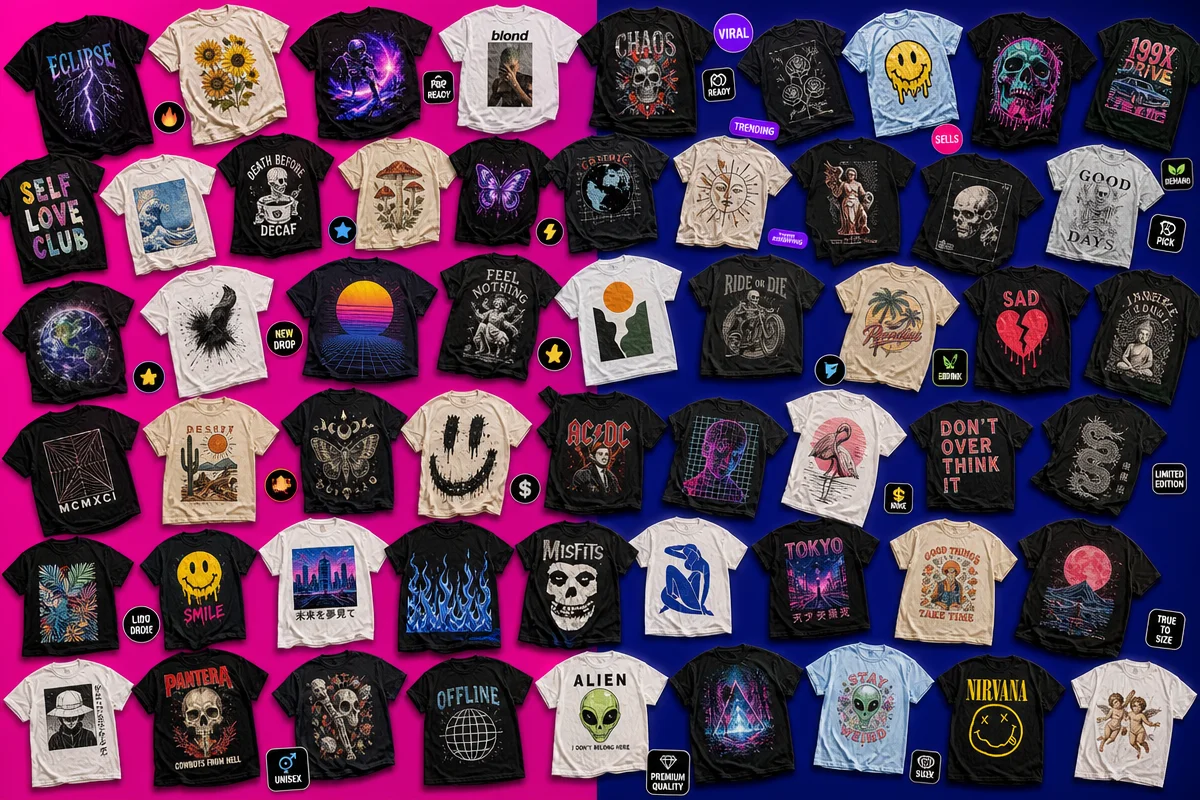
For years, “just put a cool graphic on a shirt” was enough. Not anymore. The stores winning right now aren’t guessing at trends – they’re tracking fashion influencers, dissecting what’s performing on TikTok Shop, and reverse-engineering the specific aesthetics appearing in haul videos week after week. Industry guides now catalogue over fifty distinct design directions as proven, converting categories. That level of specificity is the point.
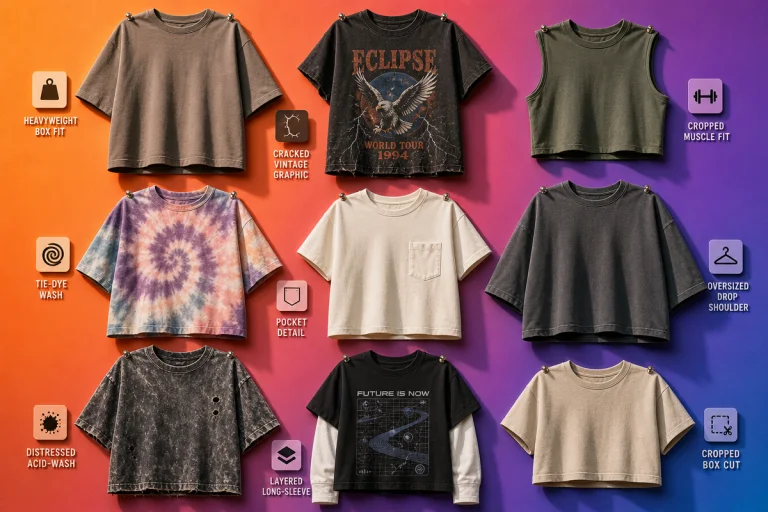
Nostalgia is the current dominant force – but the way it’s being executed in 2026 is more specific than “vintage vibes.” Think 1980s euro-tour bootleg merch meets contemporary streetwear silhouettes. A classic bootleg logo treatment – circular band name lockup, tour dates down the back, cracked ink on washed black cotton – converts because it carries twenty years of subcultural credibility in a single print. We’d run this as an oversized back print on a heavyweight boxy tee, front chest hit minimal or clean. The distress treatment matters: screen-printed cracked ink reads authentic; a Photoshop filter applied over a digital mockup reads fake immediately, and the people buying these shirts know the difference.
The colour palette for this direction is earned, not assembled. Mustard yellow, burgundy, forest green, washed slate. Not “vintage-adjacent” from a colour picker – actual period-correct choices that hold up to a customer who grew up wearing the real thing. Bleach-wash navy over natural cotton is quietly having a moment. Aged off-white on faded black is doing heavy lifting in the premium resale feeds right now.
Pop-culture references operate on the same principle. Movies, TV shows, music moments, internet memes – instantly recognisable symbols that spark recognition and signal tribal belonging. These designs convert because they do the marketing work for you. The detail that makes the difference: frame it as a bootleg, not licenced fan art. A silhouette everyone knows from a show everyone watched, treated as if it came off a bootleg market stall in 1994 rather than the official merch store. That distance from corporate is exactly what the customer is paying for.
The Categories Actually Converting Right Now
Cartoon and anime character designs are the most trending category in online clothing stores by most measures. Bold line weights, saturated colour fills, characters rendered in a style that sits between official merch and underground fan art – think Yoshitomo Nara meets Supreme drop energy. Bold line art in black on natural cotton, or a single character rendered large on an oversized silhouette with a Japanese script secondary hit below the hem. Posts featuring this aesthetic stop the scroll reliably. The detail that separates sellers from browsers: genuine craft in the line quality. Fans know the difference immediately between a vector trace and something with actual drawing intention behind it.
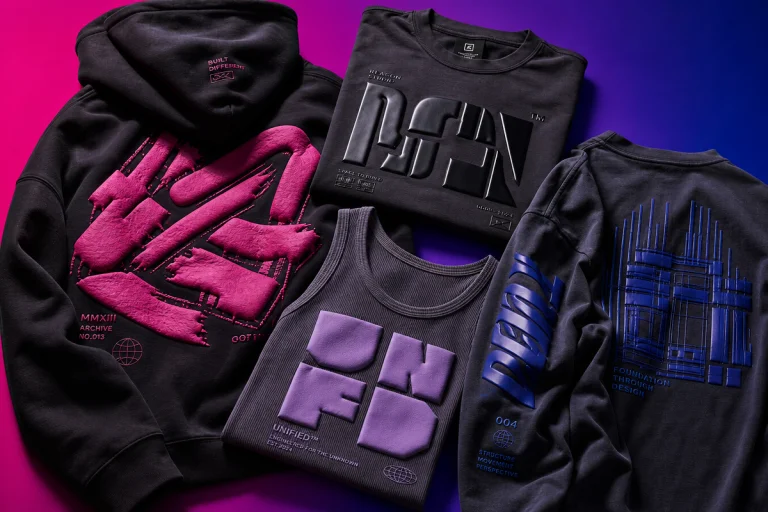
Typography is the other consistent performer. Minimalist typography shirts – a single phrase, a clean sans-serif face like Helvetica or Arial, high-contrast placement on a solid ground – keep converting because the message is the design. Right now we’re seeing two distinct type directions pulling in different directions, and both are working. The first: cracked ink collegiate serif, the kind of letter you’d find on a 1970s American sports tee, printed chest or oversized across the back. Think Yale sweatshirt meets Aimé Leon Dore reference board. The second: chrome Y2K type on a fitted baby tee or cropped ribbed tank – Diesel energy, early-2000s club flyer, almost aggressive shine on a pastel or washed white ground. These two aesthetics shouldn’t coexist in the same collection but they can absolutely coexist in the same brand if the garment silhouette separates them cleanly.
Racer-style type – narrow condensed sans, all caps, stacked like a rally car sponsor sheet – is the third direction worth building toward. Works on a long-sleeve layering piece or a lightweight zip. Think motorsport meets Balenciaga runway reference: sponsor logos in pale grey on deep navy or black.
Colour direction is specific right now. Earthy neutrals anchor the retro wave – camel, rust, off-white, washed black. Acid brights signal the Y2K and maximalist edge of the market. The AI-assisted art direction shaping this season’s visual language pushes unexpected pairings: deep burgundy on sand, bleached coral on natural cotton. Background colour is not an afterthought – it is half the design decision, and getting it wrong kills an otherwise strong concept.
What Prints Money in the Next Six Months
Well-designed shirts drive brand visibility in a way that makes every other marketing spend more efficient. A shirt worn by a real person, photographed candidly, outperforms a hundred paid impressions. That flywheel accelerates when the design is strong enough to share – and strong enough to wear again without feeling awkward about it.
The categories that will keep converting: anime and cartoon character work with genuine line craft behind it, run oversized on heavier cotton with a Japanese script detail; euro-tour bootleg logo treatments in cracked ink on washed black; collegiate serif or racer condensed type playing with sport-archive references; and chrome Y2K typography on fitted silhouettes for the maximalist end of the market. What will stall: generic motivational quotes in Canva defaults, overly complex vector scenes that dissolve into noise at thumbnail size, and anything chasing a micro-trend that peaked six weeks before your launch date.
Back to Brick Lane. The shirts that had a queue – the ones people waited in light drizzle for – shared one quality. They looked like they meant something. Whether that meaning came from a cultural reference, a distinct aesthetic, or a single perfectly chosen word did not matter. The design had a point of view. In 2026, that is the entry price.
Frequently Asked Questions
Q: What are the best t-shirt design ideas for 2026?
A: The highest-converting categories right now are anime and cartoon character designs with genuine line craft, retro and vintage distressed graphics using earthy palettes like mustard yellow and burgundy, euro-tour bootleg logo treatments in cracked ink on washed black, and minimalist typography tees built around collegiate serifs or clean condensed sans-serif fonts. Pop-culture references treated with a bootleg sensibility also drive strong and consistent conversion rates.
Q: How much does it cost to produce a print-on-demand t-shirt?
A: Base costs from major POD providers like Printify and Merchize typically run around £4-8 per unit. This low entry cost makes the category accessible to small creators, but strong design remains what determines whether a shirt actually sells rather than sitting in digital inventory.
Q: What typography styles work best on t-shirts?
A: Two directions are dominating right now. Cracked ink collegiate serif – the kind of letter from a 1970s American sports tee – works oversized across the back on a heavier boxy silhouette. Chrome Y2K condensed type on a fitted baby tee or crop works the maximalist, early-2000s angle. For a cleaner play, a single phrase in a tight clean sans-serif like Helvetica or Arial with real space around it still converts reliably. The consistent mistake is overcrowding – edit hard and let the type breathe.
Q: Are retro and vintage t-shirt designs still converting in 2026?
A: Yes – nostalgia is one of the strongest drivers in the print-on-demand market right now. The execution that’s working is specific: euro-tour bootleg logo formats, cracked ink treatments on washed black heavyweights, colour palettes like mustard yellow and forest green that feel period-correct rather than “vintage-adjacent.” The key is committing to the aesthetic authentically rather than simulating it through digital filters applied to generic artwork.
Q: Should I chase micro-trends for my t-shirt designs?
A: Generally no. Micro-trends peak and fade faster than a typical production-and-launch cycle. Durable categories – retro bootleg aesthetics, anime-influenced character work, collegiate or racer type directions, and pop-culture touchstones treated with subcultural credibility – deliver more reliable returns than designs built around a moment that may already be fading before your listing goes live.
Source: https://qikink.com/blog/tshirt-design-ideas/
This article was researched and written with AI assistance, then reviewed for accuracy and quality. Maya Sinclair uses AI tools to help produce content faster while maintaining editorial standards.